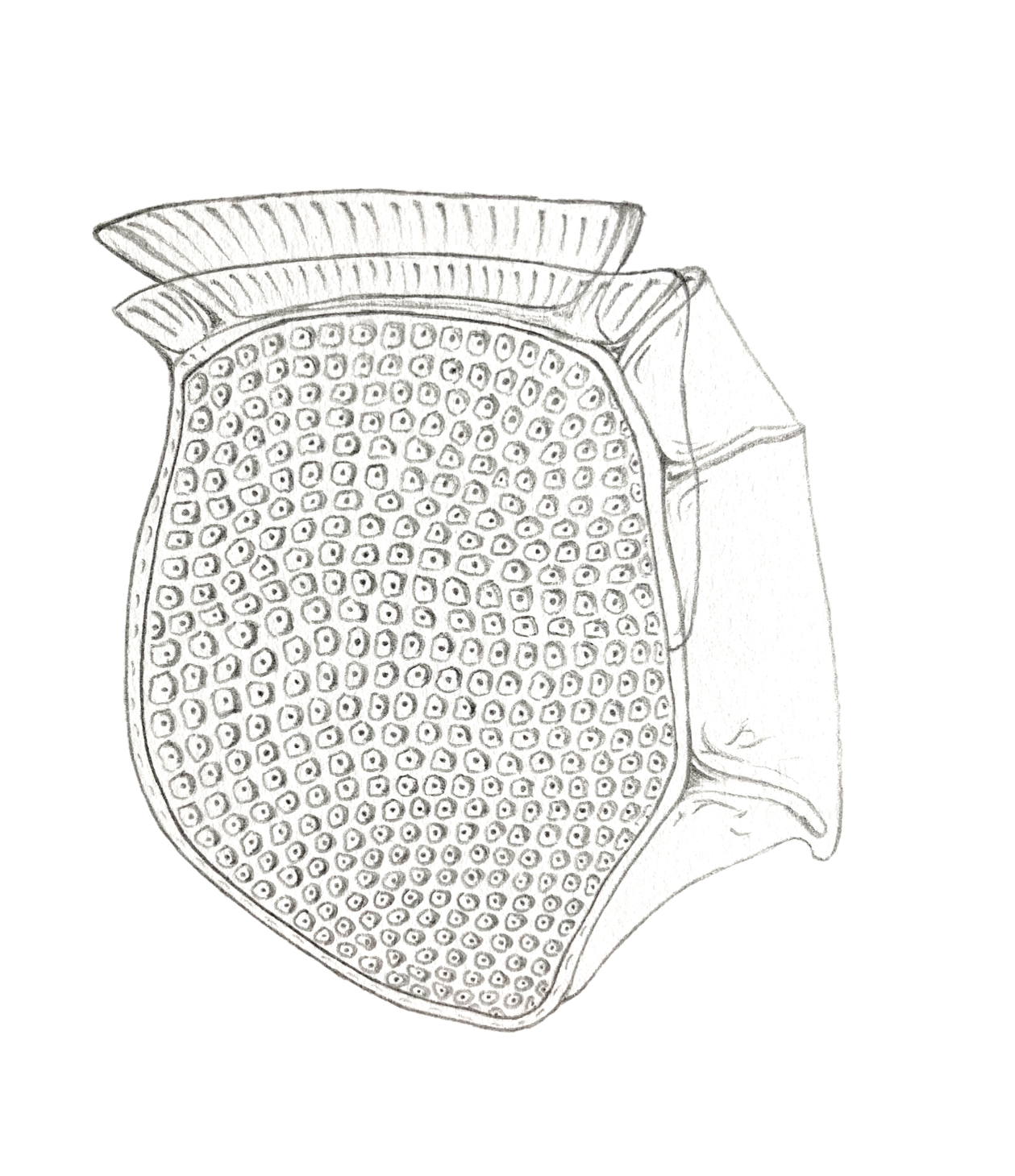
If your goal is to look for marine microorganisms, putting a drop of seawater under a microscope seems the most straightforward way. Sometimes, however, taking a step back can reveal even more. We’re talking about a big, 786-km step back – the altitude of Sentinel-2, a constellation of Earth observation satellites launched by the European Space Agency (ESA) in 2015.
Satellites have been an essential tool of oceanography for decades, because the sensors they carry allow scientists to study the ocean at scales unreachable to any other method. Satellite measurements are behind the maps of global sea temperatures produced by NASA, and the data they collect enable modellers and physicists to create some amazing stuff like this video of oceanic currents.
Most relevant to biologists, satellite sensors can document variations in the color of the ocean that are caused by fluctuations in the quantity of phytoplankton pigments in the water. The quantity of the photosynthetic pigment chlorophyll a relates directly to the amount of phytoplankton cells. If plankton is really “This Blood of the Sea”1, then this global map of chlorophyll a is showing us the pulse of the ocean.
Sentinel-2 is a bit different though. The sensors it carries have a narrower field of view than most satellites designed for oceanography, but this is paired with a much higher spatial resolution : pixels on Sentinel-2 images are only 10-20m wide. This is crucial to observe planktonic events that happen regularly in coastal waters: blooms.
A bloom results from the proliferation of planktonic microorganisms, usually photosynthetic ones, in such numbers that the colour of the sea changes dramatically. See for yourself:
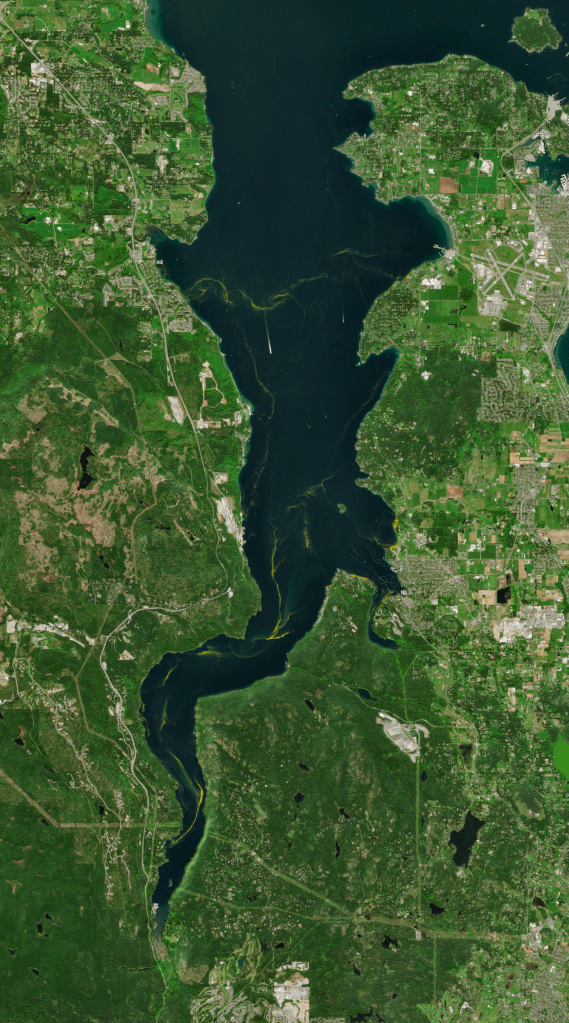
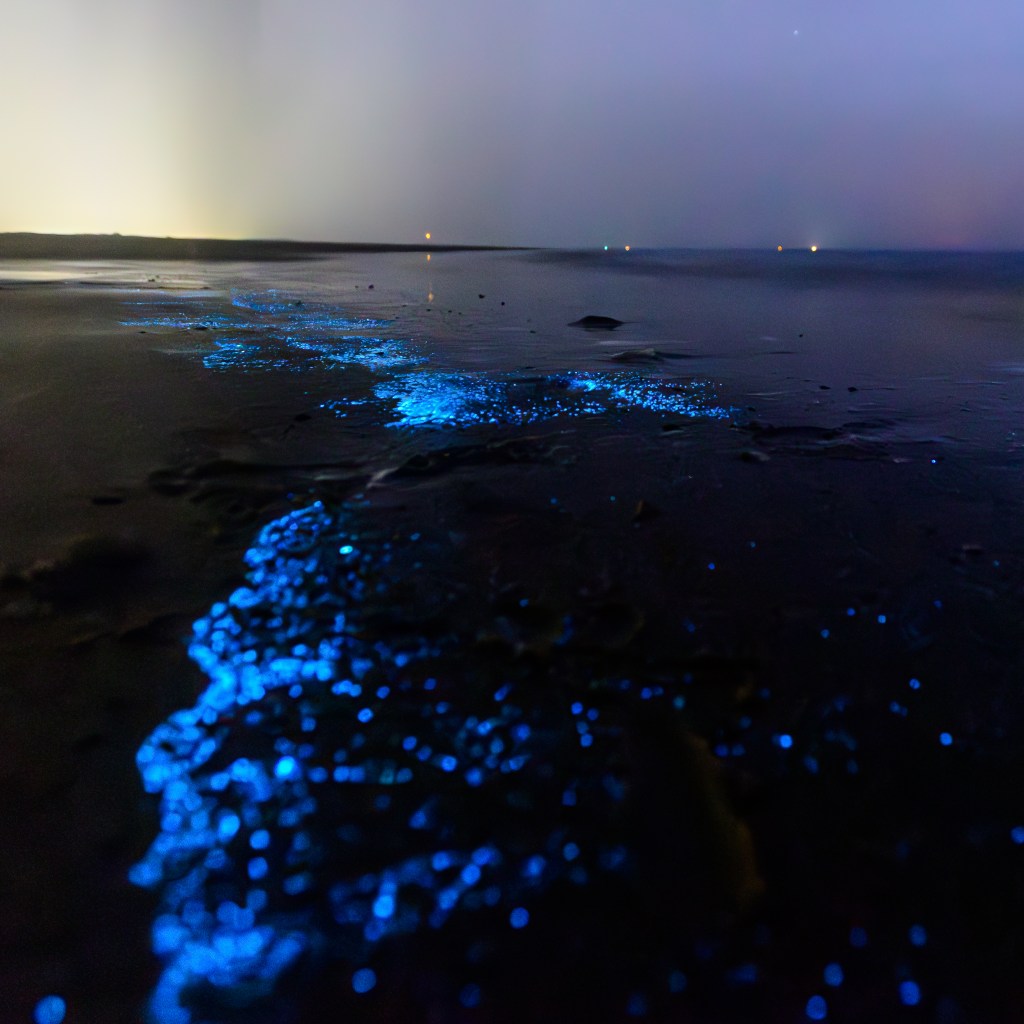
The yellow stripes that contrast sharply with the dark waters of the fjord are accumulations of cells of the dinoflagellate Noctiluca scintillans. This organism is not photosynthetic but heterotrophic, which means it’s more zooplankton than phytoplankton. Nonetheless, it often produces these beautiful blooms, like the one pictured above that occurred last month in Western Canada. At night, they colour the coastline with ghostly flashes of bioluminescence:
So now you know how to observe marine microbes without a microscope, you just need a satellite (or some luck during a night walk on the beach)! Fortunately, ESA makes Sentinel-2 images public hours after their acquisition, so you can go and look for blooms yourself. This is probably not the last post I write about satellite imagery and plankton blooms, as this is a topic I’m especially fond of.
See you next month!
This blog post and all the images it contains are under a Creative Commons Attribution License, which means you can reuse it freely as long as you give proper credit to the author(s).
- This quote is attributed to Victor Hensen, the guy that coined the term plankton! https://doi.org/10.1093/plankt/fbab045 ↩︎
 Phycoplankton
Leave a comment