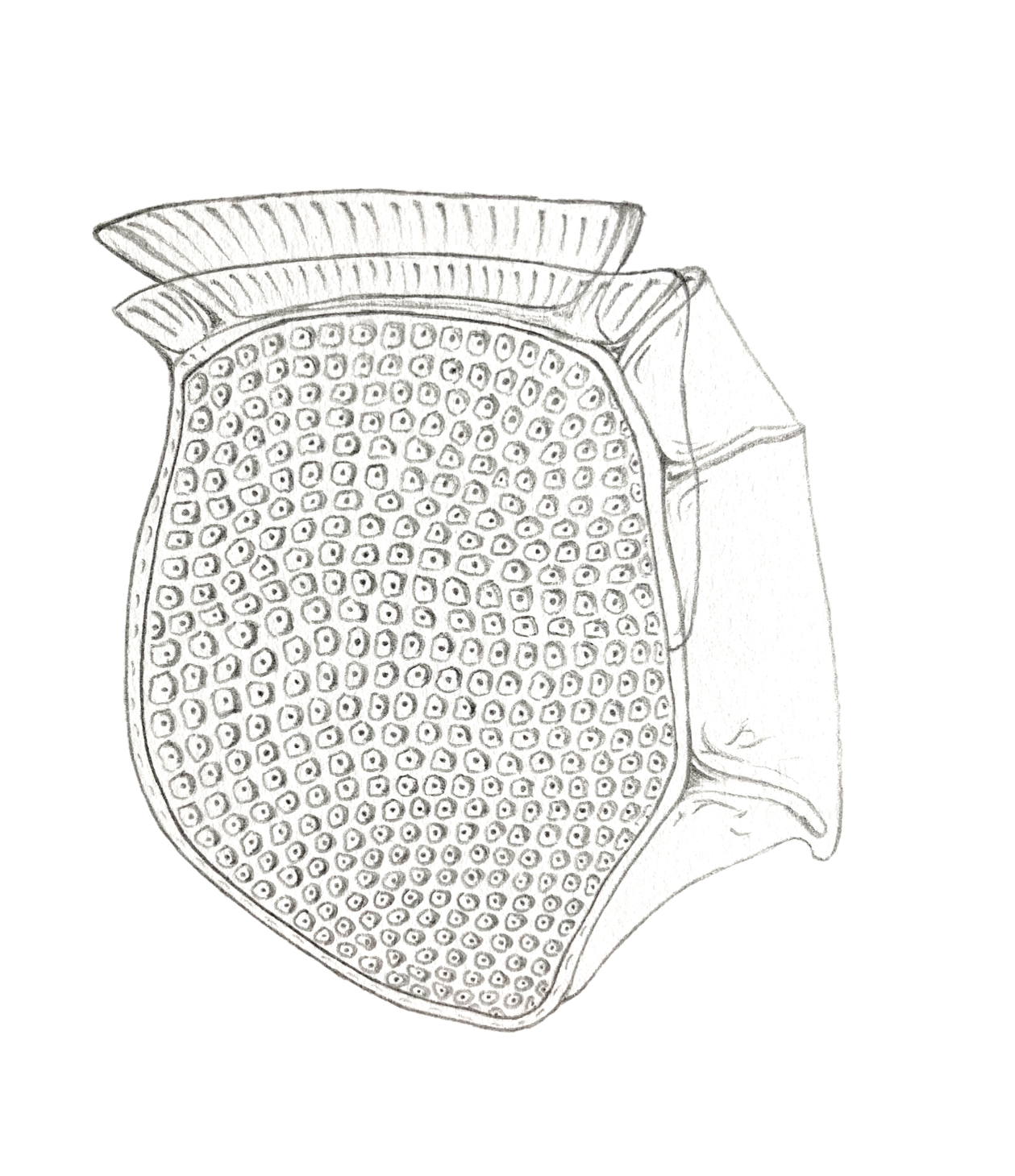
(And another funny description of a creature that, probably, doesn’t exist.)
Both I discovered in the excellent A manual of the Infusoria, by English biologist William Saville-Kent, published in 1882.
“Infusoria” was a term used at the time to encompass virtually all protozoans (that is, anything flagellate, ciliate or “tentaculiferous”) observed in water. From what I understand, the term comes from the tendency early microscopists had of dipping anything and everything in water to see what minute creatures they would discover1. It started with pepper grains, but they quickly moved to more imaginative stuff such as flowers, or horse dung. Being observed in infusions, the protozoans were named Infusoria. It is now a completely obsolete phylogenetic category, but, much like animalcule, the word still has something of an old-fashioned charm.
But I digress.
In Chapter 1 of his Manual, Saville-Kent gives a detailed account of the efforts and discoveries of pioneer protistologists of the XVIIIth century. Notably, his mentions of the works of Henry Baker and Louis Joblot caught my eye.
The first one he commends by highlighting his description of a now famous protist, that appeared in Baker’s 1753 Employment for the microscope. Even though Saville-Kent included a substantial quote of the description, I went to look for the original. Here’s a taste of Employment for the microscope‘s Chapter 5, “Of the Proteus“:
None, of the many different animalcules I have yet examined by the microscope, has ever afforded me half the pleasure, perplexity, and surprize, as that I am going to describe at present : whose ability of assuming different shapes, and those so little resembling one another, that nobody (without actually seeing its transformation performed under the eye) would believe it to be the same creature, has given me reason to distinguish it by the name of the Proteus.
[Follows a lengthy passage on how he gets some “slime” from vegetables infused over several days, that he then gathers and observes under the microscope. That’s the XVIIIth century equivalent of a Methods section.]
I was diverted with the sudden appearance of a little creature whose figure was intirely new to me, moving with great agility, and having so much seeming intention in all its motions, that my eyes were immediately fixed upon its admiration. Its body in substance and colour resembled a snail’s : the shape thereof was somewhat elliptical, but pointed at one end, whilst from the other a long, slender, and finely proportioned neck stretched itself out, and was terminated with what I judged to be an head, of a size perfectly suitable to the other parts of the animal. In short, without the least of fancy, which is ever carefully to be guarded against in the use of the microscope, the head and neck and indeed the whole appearance of the animal had no little resemblance to that of a swan ; with this difference however, that its neck was never raised above the water, as the neck of a swan is, but extended forwards, or moved from side to side, either upon the surface of the water, or in a plane nearly parallel to the surface thereof.
Ne XI, Plate X. I. is an exact representation of this extraordinary animal the first time I ever saw it.
[…]
It swam to and fro with great vivacity, but stopped now and then for a minute or two, during which time its long neck was usually unemployed, as far as it could reach, forwards, and on every side, with a somewhat slow but equable motion, like that of a snake, frequently extending thrice the length of its body, and seemingly in search of food. Fig. 2. attempts to shew it as thus described, but is unable to express the curious turn and elegance of its shape.
I could discern no eyes, nor any opening like a mouth in what appears to be the head ; but its actions plainly prove it an animal that can see ; for notwithstanding multitudes of different animalcules were swimming about in the same water, and its own progressive motion was very swift, it never struck against any of them, but directed its course between them, with a dexterity wholly unaccountable, should we suppose it destitute of sight.
This creature seemed to me so extraordinary, I could not forbear calling all my family to see it.2
Baker, Employment for the microscope (1753), Chapter 5
Ok, that was quite long, but I think you may have recognised the identity of the “Proteus“, as it appeared in last month’s post! As a final clue, here are Baker’s drawings of the Proteus:
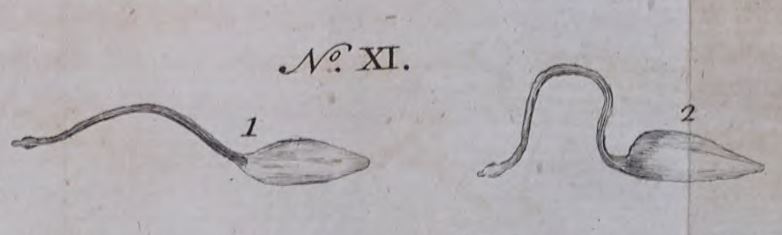
Yes, that’s our friend Lacrymaria olor, the swan ciliate! I’m completely amazed at the patience and dedication Baker must have put into these observations to make such a precise description3. All the more impressive with an XVIIIth century microscope.
Now, contrasting with his praise for Baker, Saville-Kent had some less pleasant words for Joblot. Here’s what he says of the man’s work:
Joblot, author in the year 1718 of a large treatise upon microscopes and the forms of microscopic animals to be found in various artificial infusions, was unfortunately led, through his possession of a more than ordinarily romantic
imagination, to embellish very considerably his descriptions and drawings of the various types observed, these latter being in many instances moulded by his facile pen into the similitude of satyrs’ heads, and other monstrosities having no existence in the plain and solid ground of fact.Saville-Kent, A manual of the Infusoria (1882), Chapter 1
This certainly made me curious. What mythological creatures are to be found in Joblot’s 1718 Descriptions et usages de plusieurs nouveaux microscopes… ?
Here is what he says of a creature he observed in an infusion of anemone (the flower, not the animal):
Nature, who likes to diversify its productions, and begs to be admired in all its works, continues to prove it in this infusion of anemone, prepared as usual with common water ; for after eight days we observed in a drop of this infusion a new animal, the size and looks of which we represented in [Plate 6, figure 12].
The entire upper part of its body is covered by a beautiful mask, well formed, of a human figure, perfectly made ; as one can judge from this drawing, where we see six legs and a tail, coming out from under this mask, that is topped by a peculiar crown.
Louis Joblot, Descriptions et usages de plusieurs nouveaux microscopes… (1718), Chapter XXVIII
Translated from French by myself.
“[A] beautiful mask, well formed, of a human figure, perfectly made” huh?
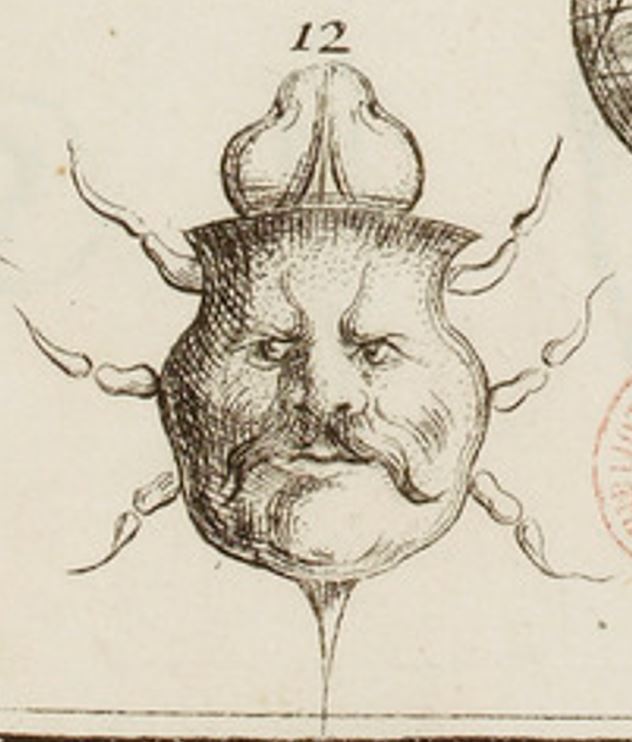
Ok, I see where Saville-Kent’s criticism is coming from. This may be a very early case of very common scientific fraud: manipulating your data (in this case, microscope observations) to make them sexier. Well, in this case, Joblot made them literally incredible. If we give him the benefit of the doubt, it’s possible that he didn’t mean wrong, but simply got carried away by his imagination and some ambiguous shapes peeked at through the lenses of a primitive microscope.
In his defence, Baker’s advice that fancy “is ever carefully to be guarded against in the use of the microscope” only came out some 35 years later.
The three books discussed here are in the public domain, and are freely accessible on the Internet4!
William Saville-Kent, A manual of the Infusoria (1882) [Google Books link]
Henry Baker, Employment for the microscope (1753) [Google Books link]
Louis Joblot, Descriptions et usages de plusieurs nouveaux microscopes… (1718) [Gallica link]
My utmost thanks to the people at Google and at the BNF who digitised these books and made them available to all of us.
These old books are such a funny and amazing read, I can only recommend checking them out. Side effects may include a sudden and noticeable dip in productivity, and delay in the writing of one’s Ph.D. introduction.
- First among the infusers was famous microscope pioneer Antonie van Leeuwenhoek. ↩︎
- This rings a bell 🙂 ↩︎
- And it does not stop there! Baker goes on describing how he noticed that the animalcule could completely retract its neck and assume a shape that made him mistake it for another creature entirely. I encourage you read the whole chapter if you’re interested, it’s well worth it. ↩︎
- As should be the case for all science. ↩︎
 Phycoplankton
Leave a comment